






As noted American philosophers Chuck Clarke and Lyle Rogers once observed, telling the truth can be dangerous business. Not only can it curtail future employment opportunities, excessive candor may prove unpopular. It might even get you killed.
Here are five stories about truth-telling.
“Clan of the Fiery Cross” — The Adventures of Superman radio serial, written by George Putnam Ludlam with Stetson Kennedy (1946)
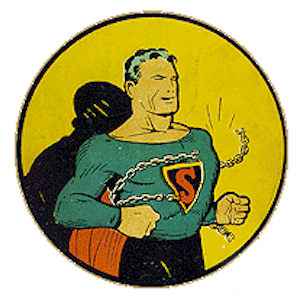
Being replaced as pitcher for the Unity House baseball team by Tommy Lee is an affront to thin-skinned Chuck Riggs. It’s also an opportunity for Chuck’s Uncle Max. Max leads the local chapter of white supremacist terrorist group Clan of the Fiery Cross. The Clan, whose remit includes job facilitation for second-rate white men, already has a bone to pick with the Lees: Tommy’s father Dr. Lee was hired for a job that could have gone to a Clan member… and Dr. Lee is Chinese.
What would have in almost any other American city been a straightforward terror campaign proves intractable in Metropolis. Metropolis is home to crusading newspaper Daily Planet. The Daily Planet staff are to a man1 and woman stalwart heroes who do not hesitate to expose the Clan for the criminal organization it is. Sure, the Clan could—and does—target the Daily Planet staff. All that accomplishes is to get the full and undivided attention of Superman.
How does one create an exciting radio serial around a character who cannot be hurt, who can, if the mood takes him, simply yeet antagonists into the sun? The solutions the Adventures of Superman writers appear to have used: first, Superman cannot be everywhere; second, the story invests a lot of time on the equally heroic but far more vulnerable supporting characters.
Ring Around the Sun by Clifford D. Simak (1953)
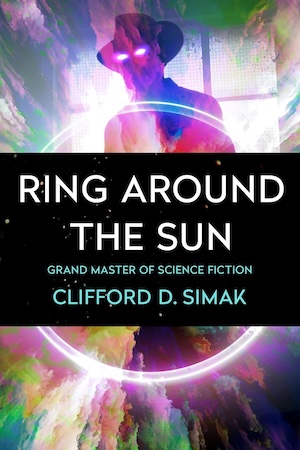
Businessman Mr. Crawford is determined to save the world. A mysterious, well-heeled organization has declared a quiet war on the West and East. Its weapons? Affordably priced, durable consumer goods. Each new product dooms another industry, sentencing workers to unemployment. The fact that legions of the unemployed are vanishing is no comfort at all. Neither is Crawford’s suspicion that the players on the other side are… MUTANTS!
Crawford turns to writer Jay Vickers to help to expose the plot against the world order. Alas for Crawford, Jay has no interest in working for Crawford. Not that lack of interest will keep Jay out of the game. Indeed, Jay (unbeknownst to him) was an active player long before Crawford reached out.
Crawford insists on seeing human-mutant relations as two species competing for the same niche, a war only one can survive. In fact, there’s no clear line between humans and mutants; many mutants have no idea they are mutants. The actual conflict is between a worldview that will surely doom us all and a better way of living. The project the mutants are working on isn’t mutant supremacy, but rehabilitating the human species.
The Truth by Terry Pratchett (2000)
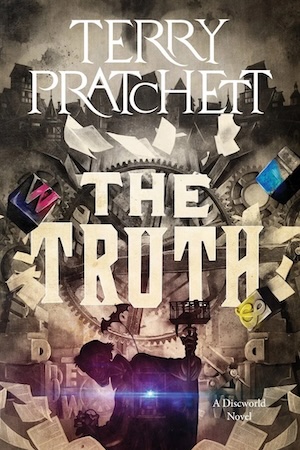
Struggling scribe William de Word sees potential in the dwarven innovation of movable type presses. One judicious partnership later, The Ankh-Morpork Times becomes Ankh-Morpork’s very first newspaper. All de Word and his associates need now is some great crisis suitable for displaying the utility of independent journalism.
The Committee to Unelect the Patrician has a bold scheme to replace Patrician Lord Vetinari with a far more tractable pawn. While the Committee’s scheme does not go entirely to plan, Lord Vetinari is successfully framed for crimes he did not commit. Everything is breaking in the Committee’s favor… except for the matter of an all-too-inquisitive newspaper.
I don’t think the Committee ever uses its initials, CUP. Nevertheless, I suspect it’s not coincidental that the Committee recalls CREEP, or that meddling journalists confound both the Committee and CREEP… except that The Truth is an inversion of Watergate, in that the reporters’ pursuit of truth allies them with their head of government.
Mermaid Scales and the Town of Sand by Yoko Komori (2013-2014)

Following the disintegration of her parents’ marriage, fourteen-year-old Tokiko returns to rustic Sunanomori for the first time since she was four. Tokiko doesn’t remember much about the small town. She does remember one thing quite clearly: this is where Tokiko was saved from drowning… by a merman.
Merfolk figure prominently in local legend. However, nobody in Sunanomori believes merfolk are real. At least, the adults are adamant that merfolk do not exist. And yet, a merman saved Tokiko. Are the adults lying? If they are, what dread secret are they hiding?
It might be logical to conclude that Sunanomori is Japan’s answer to Innsmouth, that the manga ends with adorable Tokiko being dragged to a watery doom by Japanese Deep Ones. There are no Deep Ones! Instead, there is all too many needlessly obfuscatory adults whose solution, when their lies produce tragic results, is to double down.
The Language of Liars by S.L. Huang (2026)
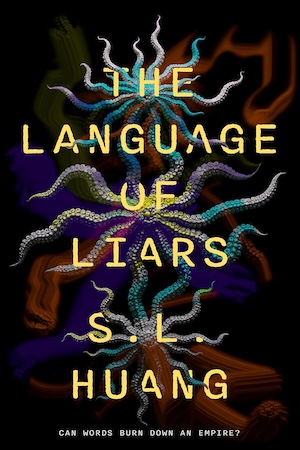
The Star Eaters are the only beings in the galaxy able to locate and mine the precious meridian element on which all star flight depends. Once enslaved by the other galactic civilizations, the Star Eaters were graciously freed… although the Galactics left their robotic Overseers in place to help keep the Star Eaters focused on relentless productivity.
A crisis looms. For reasons unknown, the Star Eaters’ birthrate has fallen to zero. Star Eaters are long-lived but not immortal. Once the last Star Eater dies, there will be no more meridian, no more star flight, and no more civilization. Linguist Ro sets out to discover why the seemingly compliant Star Eaters no longer have children. Ro finds the answers… but little comfort.
I was struck by a parallel between how the Galactics treat Star Eaters and the circumstances of the Lll in Delany’s Empire Star. Both have their sympathizers and both are far too useful to be actually provided with meaningful autonomy. I don’t think Huang was directly inspired by Delany, though. It’s likely a case of Huang and Delany being inspired by similar real-world events.
Secrets and revelations are so common in SFF that two of the above synopses are of books I happen to have read in the last week2. No doubt you have your own favorites! Comments are below.
- With the possible exception of timorous Clark Kent, who keeps finding reasons to step out of the room whenever there is a crisis. Clark “Superman” Kent barely tries to conceal his powers in this particular serial, which made me wonder if he really does have a secret identity or if the other Daily Planet staff members are just humouring him. ↩︎
- Speaking of books I read in the last week, one of the books I read in the last week is on my 2026 Best Novel Hugo list. In fact, right now that book is my 2026 Best Novel Hugo List. And that book is… ah, but I’ve used up my word count. ↩︎

I would add City of Truth by James Morrow to this list. It’s a satire where all citizens are conditioned during childhood by pain reinforcement to tell nothing but the absolute truth. In addition to just not lying, everyone always tells exactly what they are thinking, with no attempt to put things in a better light. Part of the plot is deconditioning people so they are able to lie again.
As for how the radio series got around Superman’s nigh-invulnerability, it tended to rely a lot on delaying Clark Kent from discovering his friends were in danger. Once he did find out, he usually made short work of the problem, since the radio series rarely pit him against any superpowered foes, other than the kryptonite-powered Atom Man, and one villain with a Black Canary-like super-loud voice that Superman’s enhanced hearing made him vulnerable to. Even when they wrote in a robot inspired by the ones in the second Fleischer cartoon that had just come out, Superman only fought it twice in the course of the multi-week serial and made short work of it each time. In one of the two battles, IIRC, Superman had more trouble putting out the fires resulting from the robot attack than dealing with the robot itself.
“Clan of the Fiery Cross” took good advantage of the radio format, since it started out introducing this cool kid named Tommy Lee and getting the audience to like him and wonder why Chuck had such a problem with him, and only then did they reveal that he was Chinese-American.
I believe this is the serial where they deliberately inflated the Klan and used much of the secret passwords and mumbo-jumbo, so the Klansmen saw their inmost rituals being shrieked out in children’s games before Superman beat them up.
What bugs me is that “Clan of the Fiery Cross” gets all the attention, but it was actually the second of two 1946 radio storylines about Superman fighting demagogues stirring up hatred for political gain, with only one other storyline separating them. The first one was called “The Hate Mongers’ Organization,” and if I recall, it was about a group stirring up anti-immigrant xenophobia as a cover for advancing a fascist agenda.
The Superman radio series was very politically activist in 1946-7, speaking out against fascism, hatemongering, and political corruption in stories that feel very timely today. When I first listened to them some years back, I found the villains to be implausibly broad and cartoonish in their villainy, although now I know that if anything, they were understated.
Gene Luen Yang did an adaptation of this story into comics a few years back, titled “Superman vs. the Klan”. It was pretty good.
There’s a nice bit towards the end of Clan where Uncle Max’s boss in the Clan is astonished to discover Max has bought into the whole white supremacy thing. That’s just a line they feed the rubes so they can rob them blind and the fact Max has fallen for it means he was promoted above his level of competence.
I wonder how many listeners applied this concept to the real world and came away convinced that racism was invented as an excuse for colonialist exploitation.
Oh that is lovely
Four-Day Planet by Piper has a newspaperman almost end up in the obits a couple of times.
An inversion of this idea, perhaps, is the film The Invention of Lying with Ricky Gervais
Lee Killough’s A Voice of Ramah features a world with a native disease that kills almost every male exposed to it. As a result, the population is mostly women, with a few men enjoying elevated status. An obvious question is why, if some men are resistant and only resistant men live long enough to have kids, the disease is killing most of the boys centuries after settlement. There are a number of reasons why this could be. The reason in this case is that everyone on the planet is immune but to preserve the social order, the priests secretly randomly poison the vast majority of teen boys.
In a lot of novels, that would revealed near the end. In this one, a major character discovers the secret early on. The novel is about what happens when he decides he cannot bear to run the risk of a blood-relative being murdered for the greater good.
You know, a good title for this essay might have been, “You Can’t Handle the Truth.”
There is are Chattering Sisters of St Beryl, in Good Omens, who are under a vow to constantly say whatever is on their minds: a kind of petty truth-telling that doesn’t so much endangder them as annoy non-Sisters.
In Asimov’s “Black Widower” stories, the club’s waiter, Henry, who inevitably solved the mystery of the month, was one of those people psychologically incapable of lying; and in an early story, their guest also had that odd disability, which was how the mystery was resolved.
Meanwhile back at SFF. . .
In more than one SFF story — indeed, in quite a few — the protagonist has been subjected by the villain(s) to an infallible lie detector (or a chemical/spell which makes them incapable of lying), and we are meant to marvel at their cleverness in making carefully crafted true statement which mislead the villain(s). As a very simple example, I’m sure you recall Bilbo Baggins doing this very thing, with no spell or lie detector, simply to keep Smaug interested.
I recall one by Randall Garrett titled “The Best Policy”, which used dodges like having the pronoun “we” sometimes mean the protagonist’s family, sometimes humanity as a whole, sometimes just the colonists on the particular planet where he’s from.
Sharon Shinn’s The Truth-Teller’s Tale. She’s got a number of YA novels like this which really land with me.
Sort of inverted, but I liked the line in one of Graydon Saunders Commonweal books where an MP decides to check the new Shape of Power is working properly by telling outrageous lies. Correct functionality is confirmed when his trousers start smouldering…
Regarding Note 1: There’s fanon that Smallville is just small enough and isolated enough to successfully carry out a conspiracy. The conspiracy is, “If you see the Kent kid doing something humanly impossible, no you didn’t.“
I wonder what the Smallville show would have been like had it stuck to the sheriff’s POV, without explaining why sometimes tractors fall out of the sky.
Smallville‘s Clark couldn’t fly (with rare exceptions) until the series finale, so that wouldn’t have happened much. (They expected to do a 5-year arc but had to stretch it out to 10 seasons, so it got increasingly contrived that Clark couldn’t fly and didn’t call himself Superman even after he’d begun his crimefighting career in Metropolis.)
I suspect that the Daily Planet staff in the 2025 movie knows that Clark is Superman, because Perry and Jimmy knew that Superman and Lois had been hooking up, and they’ve presumably seen Lois interact with Clark in the newsroom a lot more than they’ve seen her interact with Superman out in the field. And in the newsroom scene, Clark and Lois were being so self-consciously adversarial to hide their relationship that I think observant reporters would’ve seen right through it.
Incidentally, Smallville wasn’t introduced until 1949 (and wasn’t placed in Kansas until the 1978 movie). In the ’40s radio series, Clark grew up in or near Centerville, Iowa.
I too thought immediately about freeing the LLL.
I immediately thought of Heinlein’s “Life-line”.